this in JavaScript: The Actor Who Changes Roles

What is this in JavaScript ?
In almost all other languages, conditionals, loops, functions and these basic things are almost the same. But in JavaScript, this is a keyword that makes JavaScript different.
this also exists in other languages, but in JavaScript it is used at a very high level. And after learning this , we can easily understand call, apply, bind and new later.
this in Real World:
Just suppose this is an actor. The same actor plays different roles in different movies. Actor is same, but the role depends on the movie.
In the same way, the value of this is not fixed. It depends on where and how the code is run.
Or understand it like this: every person behaves different in his own area. At home different, in office different. this also changes according to its environment.
this in the Global Context
Global context means: no function, no object, just this is written.
console.log(this);
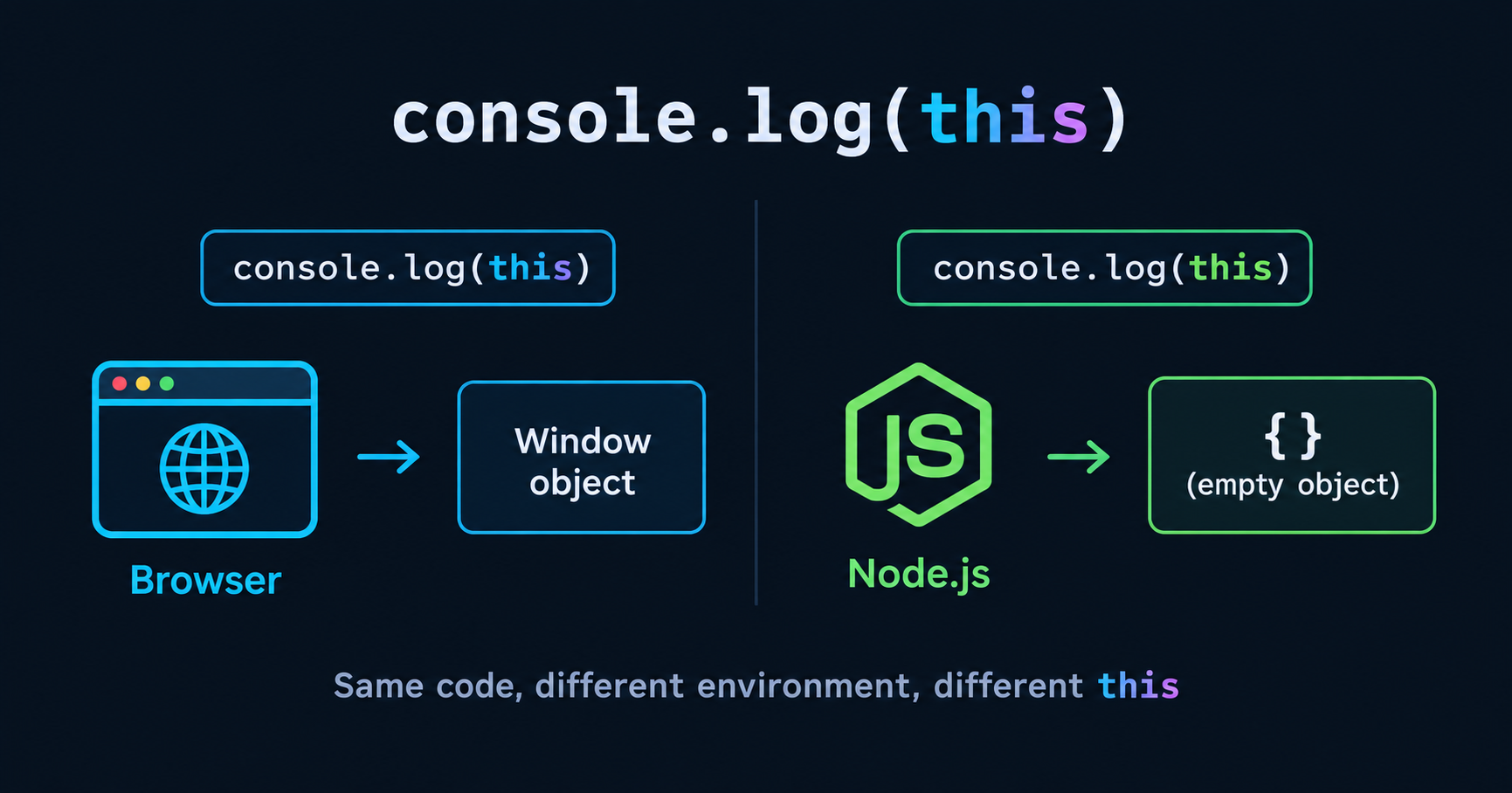
In Browser console: we get the
WindowobjectIn Node.js: we get an empty object
{}
Code is same, but environment is different, that`s why this is different.
Small Update for Node.js:
The
{}result comes when your file is a CommonJS module (the one which usesrequire).But if you use ES Modules (the one which uses
import), thenthiswill beundefinedthere.
// CommonJS file (require)
console.log(this); // {}

// ES Module file (import)
console.log(this); // undefined
As we can see visually in the diagram below:
this Inside Objects
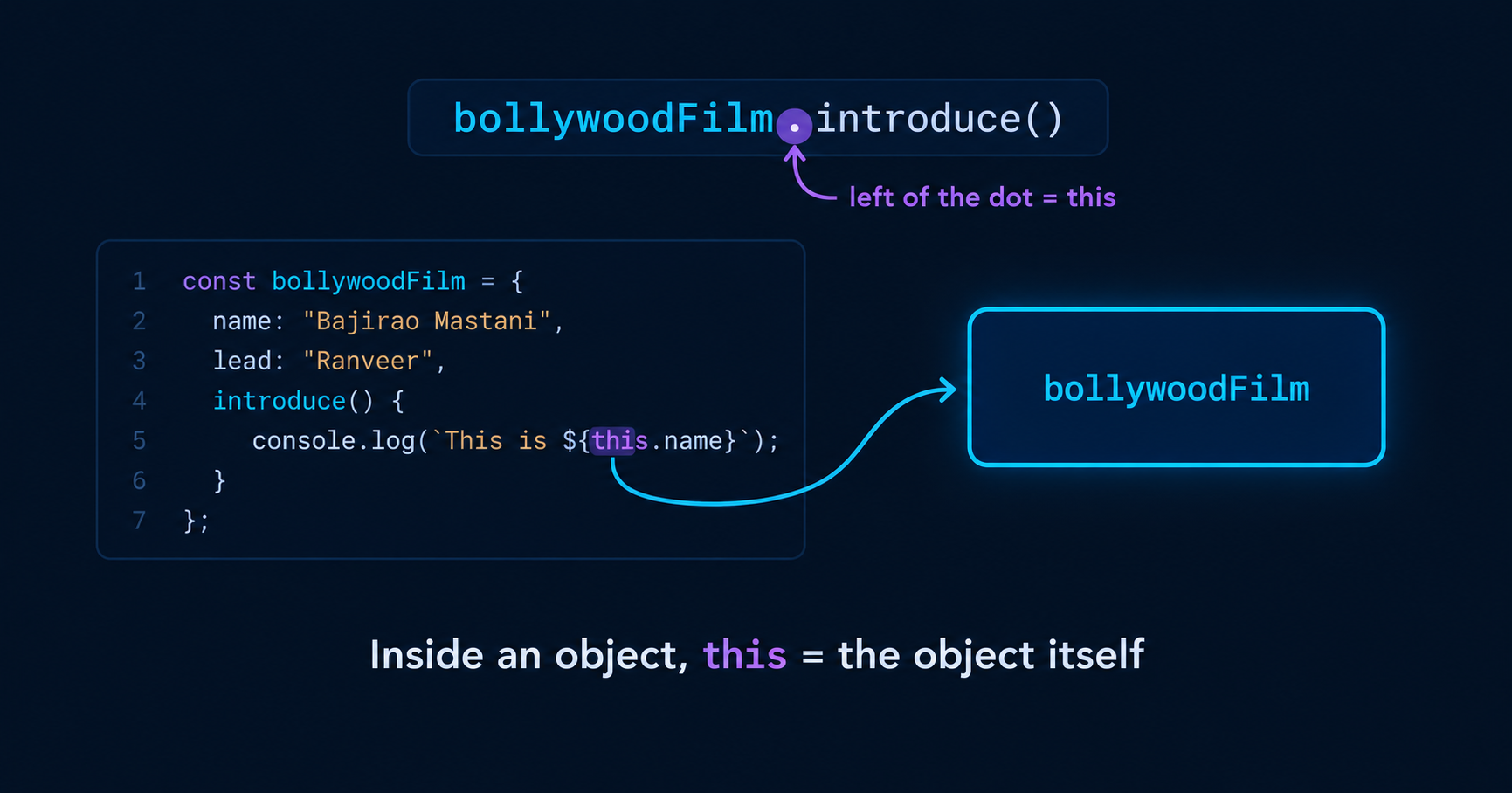
Inside an object, this points to that same object. It is like the object is saying "my own properties". So with this, we can easily access other properties of the same object from inside its method.
const bollywoodFilm = {
    name: "Bajirao Mastani",
    lead: "Ranveer",
    introduce() {
        return `${this.lead} performs in ${this.name}`;
    },
};

console.log(bollywoodFilm.introduce());
// Output: Ranveer performs in Bajirao Mastani
Here introduce() is called by bollywoodFilm, so this = bollywoodFilm. That is why this.lead gives "Ranveer" and this.name gives "Bajirao Mastani".
Easy way to Remember: Look at the left side of the dot. this is calling the method.
bollywoodFilm.introduce();
// ↑ left of the dot = bollywoodFilm = this
That`s how we can easily use this anywhere inside the object's methods, but remember, it works properly with regular methods. Arrow functions are different.
this Inside Functions
Now let's see this inside a normal function, which is not inside any object.
function showThis() {
    return typeof this;
}

console.log(showThis());
// Output: object
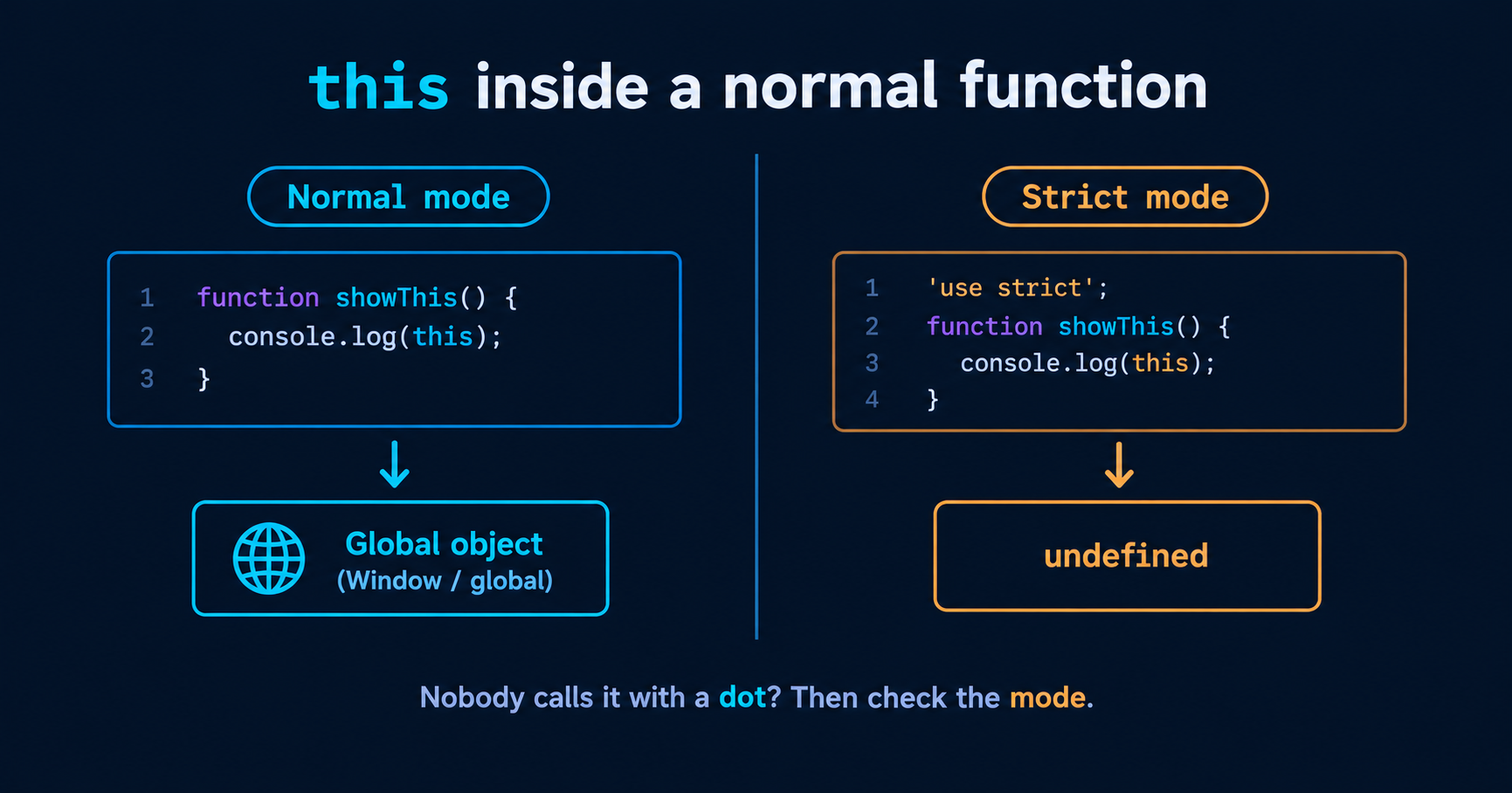
Here nobody is calling the function with a dot, so this becomes the global object.
In Browser:
WindowobjectIn Node.js: Nodejs
globalobject
But using Strict Mode :
If we write "use strict" inside the function, the result will be different.
function showThisStrict() {
    "use strict";
    return typeof this;
}

console.log(showThisStrict());
// Output: undefined
In strict mode, JavaScript does not give the global object. this is just undefined.
Strict mode is safer, because we don't accidentally touch the global object.
Quick Summary
| Function type | Value of this |
|---|---|
| Normal function (no strict) | Global object |
| Normal function (strict mode) | undefined |
In a function, always check who is calling it. If nobody is calling it with a dot, then this is global object (or undefined in strict mode).
How Calling Context Changes this
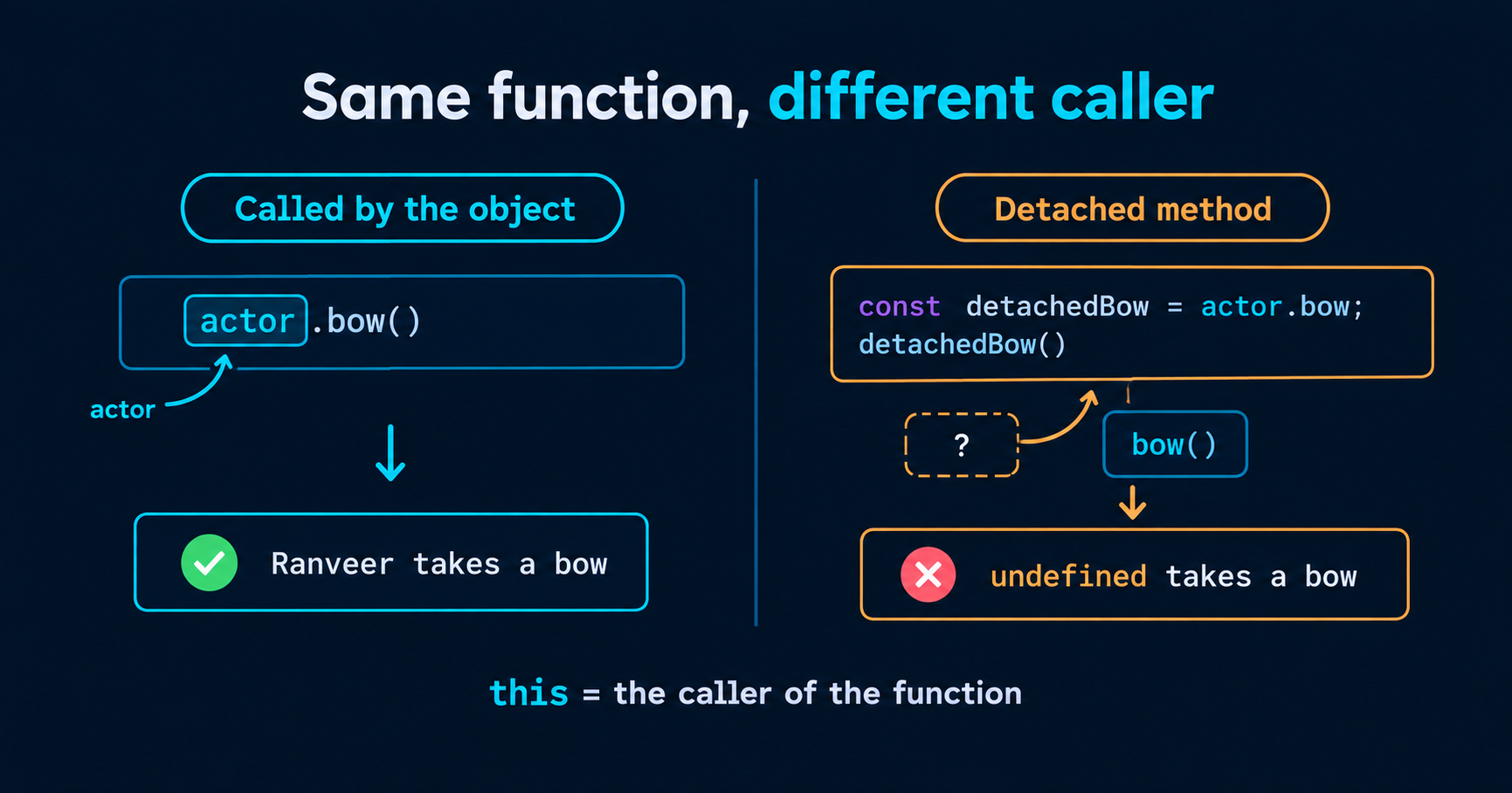
The most important point: this does not depend on where the function is written. It depends on who is calling it.
javascript
const actor = {
    name: "Ranveer",
    bow() {
        return `${this.name} takes a bow`;
    },
};

console.log(actor.bow());
// Output: Ranveer takes a bow

const detachedBow = actor.bow;
console.log(detachedBow());
// Output: undefined takes a bow
In the first call, actor is calling bow(), so this = actor.
In the second call, we took the method out of the object and called it alone. Now nobody is on the left of the dot, so this is lost. This is called a detached method: the method loses its context.
Quick Note:
Global context:
Windowin browser,{}in Node.js (CommonJS)Inside object method:
this= the object itselfInside normal function: global object, or
undefinedin strict modeCalling context: always check who is calling the function
You can find more of my work at abdulrdeveloper.me
Read more posts at blog.abdulrdeveloper.me


